Table of contents
The compliance risk facing American businesses changed overnight, and most employers have not heard about it.
In March 2026, the US government quietly updated the rules around Form I-9, the document every employer must complete for every hire. More than ten common paperwork errors that were previously fixable for free became instantly fineable, with penalties of up to $2,861 per form.
To understand the scale of the change, we modeled the hidden fine liability across US private employers using federal penalty data, Bureau of Labor Statistics employment figures, and ICE’s enforcement framework.
The result is a ranked index showing where businesses face the greatest exposure, revealing that the employers most at risk are not always the biggest, but often the least prepared.
Key findings
- US private employers could now be exposed to as much as $312.9 billion in hidden Form I-9 fines under the new March 2026 rules, with even conservative estimates putting the total at $131.2 billion.
- The rules changed on March 16, 2026 with no Federal Register notice, no rulemaking, and no public warning. More than ten of the most common errors lost their correction window in a single day.
- The health care and social assistance sector faces the biggest potential exposure, with up to $54.8 billion in possible Form I-9 fines, accounting for 17.5% of the national total. Retail and accommodation and food services follow behind.
- A business with just 50 Form I-9 errors could now face fines of up to $143,050. Even a typical 50-employee company could be exposed to around $48,600 in penalties before legal fees are added.
- Every employee on a company’s payroll now represents between $78 and $2,317 in potential Form I-9 fine exposure.
- ICE issued more than 10 times as many audit notices in the first half of 2025 as it did across the whole of 2024, when only around 230 notices were issued.
- Large companies account for around 47% of the total fine exposure, but smaller businesses are likely to feel the biggest financial impact relative to their size and resources.
The industries most exposed to I-9 Fines
1. Health care and social assistance - up to $54.8 billion in exposure
Health care tops the index on the strength of sheer scale. It employs more workers requiring Form I-9 records than any other private sector in the US. High staff turnover in areas like home care, nursing support, and social services also means employers are continually adding new forms while legally retaining records for former employees for years, significantly increasing the total number of forms on file.
Why it ranks here:
- An estimated 31.9 million I-9 forms on file, the largest count of any sector
- A private workforce of roughly 23.7 million, the biggest employer base in the study
- Flagged as a high-risk ICE inspection target in 2025 enforcement reporting
- High turnover multiplies the number of retained forms an employer must keep and produce
- 17.5% of total national exposure, more than any other industry
2. Retail trade - up to $35.7 billion in exposure
Retail's second-place finish is driven almost entirely by volume. Seasonal and high-churn hiring inflates the number of retained forms long after staff have moved on, and each of those forms is now a potential line item in a penalty calculation.
Why it ranks here:
- An estimated 20.8 million I-9 forms on file
- Seasonal and high-turnover hiring inflates retained-form counts
- Not currently named a high-risk sector, yet raw volume still places it second
- 11.4% of national exposure
3. Accommodation and food services - up to $33.0 billion in exposure
Hospitality combines two of the worst-case ingredients: relentless turnover and direct enforcement attention. It has been named repeatedly as an ICE inspection priority, which means its exposure is not just large on paper but unusually likely to be tested in practice.
Why it ranks here:
- An estimated 19.2 million I-9 forms on file
- Flagged as a high-risk sector and named repeatedly in enforcement reporting
- Among the highest staff turnover rates in the entire economy
- 10.6% of national exposure
4. Manufacturing - up to $29.2 billion in exposure
Manufacturing pairs a large frontline workforce with multi-site operations, which is exactly the structure that makes consistent I-9 record-keeping hardest. Errors at one plant rarely look like errors at another until an auditor lines them all up.
Why it ranks here:
- An estimated 17.0 million I-9 forms on file
- Flagged as a high-risk sector
- Large frontline workforces spread across multiple locations
- 9.3% of national exposure
5. Professional, scientific, and technical services - up to $25.1 billion in exposure
The first white-collar entry in the top five, professional services lands here on workforce size rather than enforcement heat. It is not a flagged high-risk sector, but its scale alone produces tens of billions in latent exposure.
Why it ranks here:
- An estimated 14.6 million I-9 forms on file
- A large professional workforce of more than 10 million
- Not currently flagged as high-risk
- 8.0% of national exposure
The surprising exposure: sectors that punch above their weight
The largest industries show the biggest total fine exposure because they employ more workers, but that does not always mean they are the most at risk on an individual form basis.
- Administrative and support services (staffing and temp agencies) rank sixth overall at $19.6 billion in exposure. High employee turnover means every placement requires a separate I-9, creating a large volume of potential errors and making the sector a key ICE enforcement target.
- Construction ranks seventh at $19.2 billion. Project-based hiring, subcontracting, and its high-risk enforcement status make it one of the industries most likely to face a Notice of Inspection.
- Even lower-ranked sectors such as utilities and mining/logging, both at roughly $1.4 billion, still carry exposure. Every employer with staff has I-9 forms, and every form is now in scope under the updated rules.
Big businesses face higher exposure, small businesses face higher pressure
Exposure rises with company size across the board: more employees means more forms, so both the total bill and the average fine per firm climb. The largest firms face the biggest numbers, full stop. But the per-firm figures carry a warning the totals hide for smaller employers.
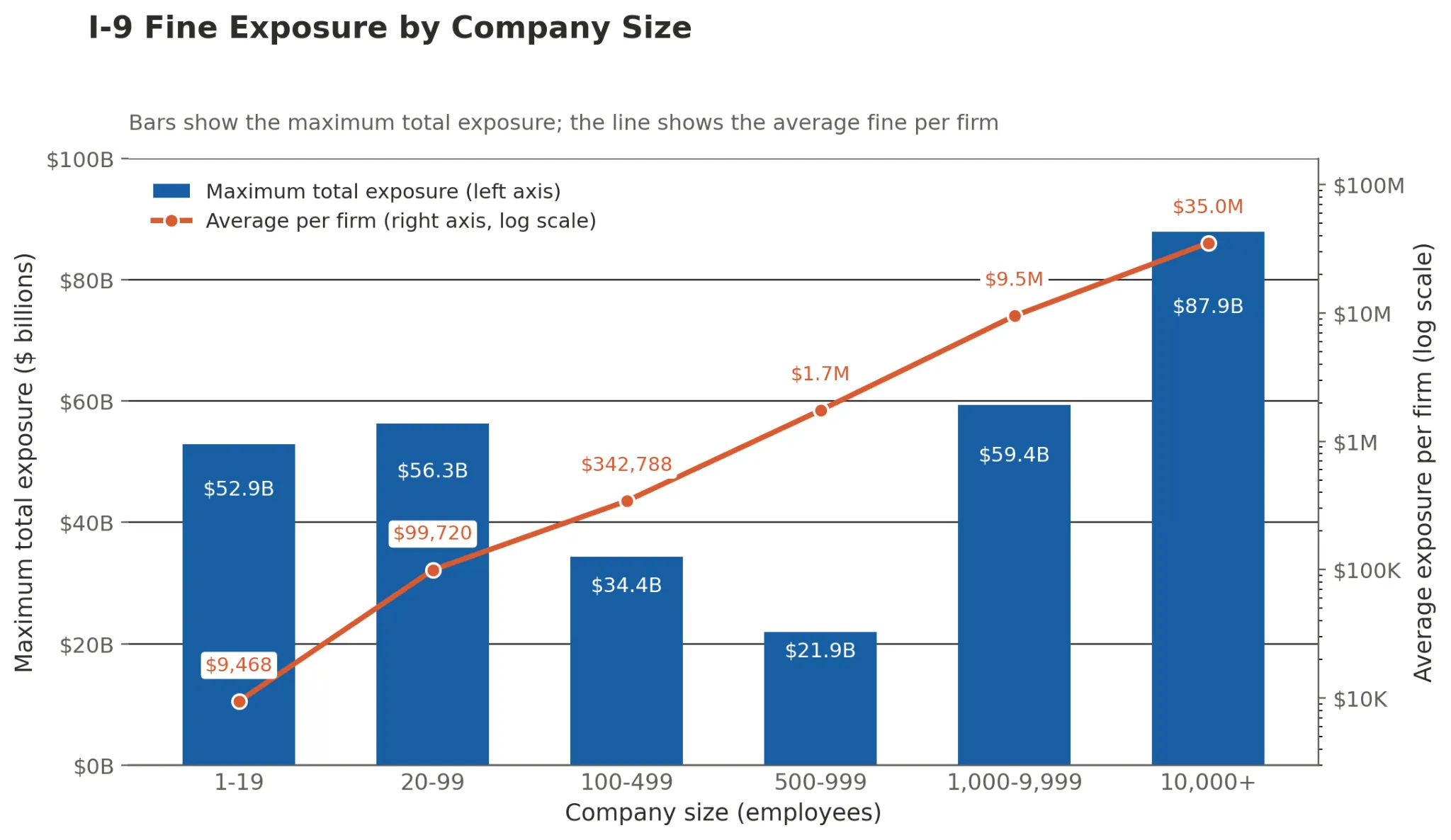
Large companies with 1,000+ employees account for around 47% of US private employment, meaning they carry a large share of the total Form I-9 fine exposure. But smaller businesses collectively face almost as much risk, with firms employing 1–19 people carrying an estimated $52.9 billion in exposure.
The difference is impact. A multi-million dollar fine is far easier for a large company to absorb than a five-figure penalty for a small business with no HR team or compliance support.
In many cases, the businesses least equipped to handle a fine are the ones most exposed to one. A company with just 50 Form I-9 errors could now face penalties of up to $143,050 under the new rules.
The states most affected
Exposure closely tracks employment levels, meaning states with the largest private-sector workforces face the biggest potential financial hit. California alone accounts for $35.9 billion in maximum-case exposure, more than the 20 least-affected states combined.
- California leads due to its massive private workforce, giving it the highest number of I-9 forms and potential fineable errors. Large hospitality, agriculture, and logistics industries further increase exposure.
- Texas and Florida also rank highly due to rapidly growing workforces and large hospitality and construction sectors.
- In New York, exposure is concentrated across finance, health care, and hospitality industries in the New York City metro area.
Smaller states rank lower mainly because they have fewer businesses and workers overall. However, while some states carry larger overall exposure, individual businesses face the same per-form penalties regardless of location. A 60-person restaurant in Wyoming faces the same penalties as one in California.
What changed in March 2026 (and why it matters)
On March 16, 2026, ICE tightened I-9 enforcement rules by reclassifying more than 10 common mistakes, including missing employment dates, incomplete document details, and missing initials, from correctable errors into immediate violations. Employers can now face fines of $288 to $2,861 per form, with no opportunity to fix many errors once an inspection begins.
The change comes during a major enforcement surge, with ICE inspections running at more than 10 times 2024 levels. Once notified, employers have just three business days to provide records.
As a result, the biggest risk is no longer intent, it’s organization. Businesses relying on paper files or disorganized PDFs are now far more exposed, while companies with searchable, auditable records and compliant electronic I-9 systems are far better protected during audits.
“The data makes clear that I-9 compliance has quietly become one of the largest unmanaged liabilities on the American balance sheet. The difference between a clean inspection and a six-figure fine increasingly comes down to whether a business can quickly find, verify, and audit its own records before ICE does.” said Jackson Barrett, Director of Product at Xodo Sign.
Methodology
We estimated the number of I-9 forms on file by multiplying each employer’s workforce by 1.35, reflecting federal retention requirements. We then applied estimated substantive error rates of 20% (low), 40% (mid), and 60% (high), based on industry findings that 65% to 75% of I-9 forms contain errors.
Each affected form was assigned the current federal penalty range of $288 to $2,861 per violation. Employment data came from the Bureau of Labor Statistics (January 2026), while business size data was sourced from the U.S. Census SUSB and SBA.
The estimates cover paperwork violations only and exclude knowingly hiring unauthorized workers, continuing-employment violations, and document fraud penalties. Figures are illustrative estimates and not legal advice.